
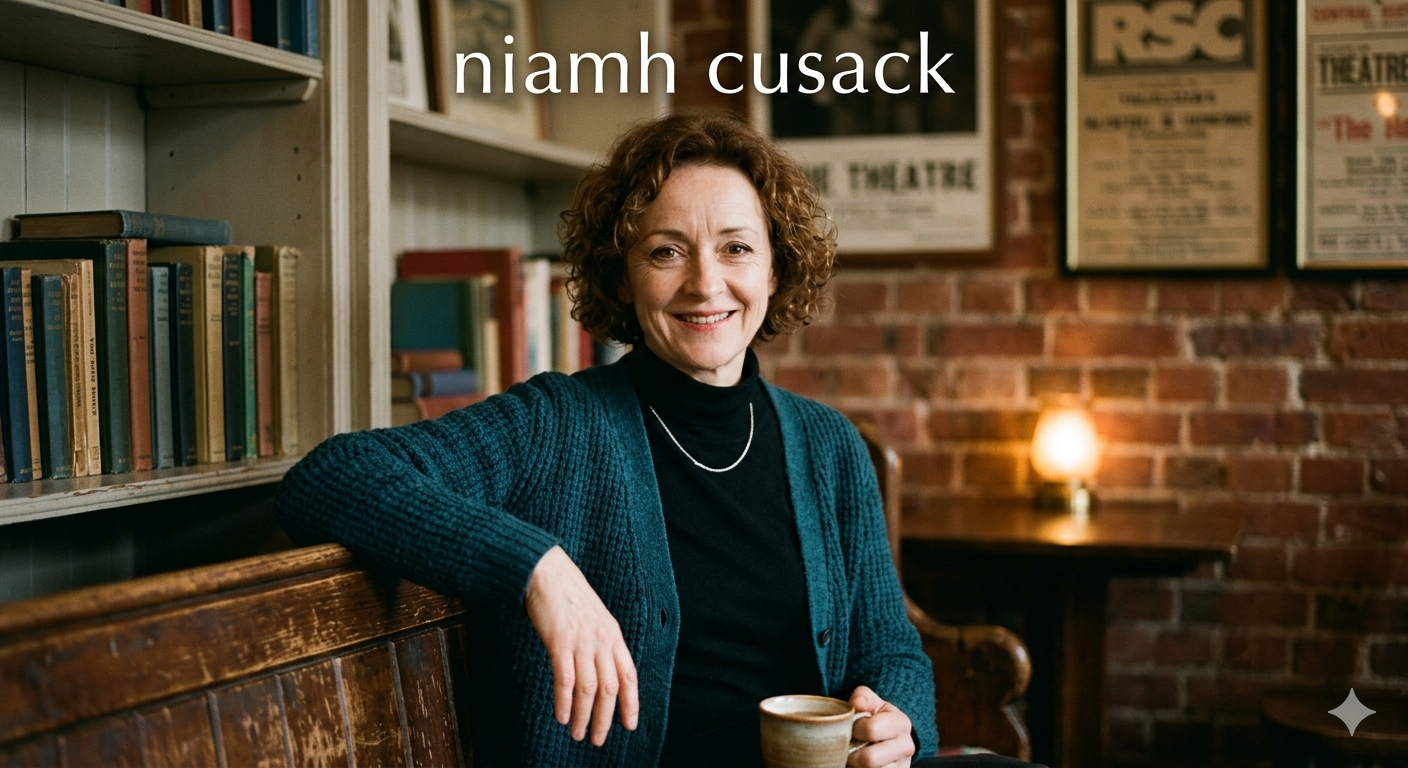

Niamh Cusack isn’t just someone whose name you recall from seeing a cast list; she is a lesson in the craft of the slow burn. In a world ever-hungry for the “next big thing,” not to mention twenty-something starlets who disappear by age thirty, Niamh has done the impossible. Her relevance, vibrancy and superlative consistency have endured across four decades. But here’s what gets lost: the sweaty biographical grit that it takes to pivot from the RSC then to prime-time television and back across the Thames into the West End. We take her longevity for granted, but it’s a relatable defiance of the status quo.
You know, most actors find their lane, and they stick in it. They are “the detective” or “the period drama lead.” Niamh refuses the box. Whether she’s portraying a grieving mother or perhaps a razor-sharp academic, under everything she does is the pulse of raw, human nerves. This is not about celebrity; this is a horse of an endurance craftsperson. We’re going to be getting under the skin of why Niamh Cusack is still one of acting’s most vital forces, moving beyond the broad brush strokes of trivia and hitting you with what lies at the very heart of her career.
Her Journey Matters: Because of the Weight of the Name
To appreciate Niamh Cusack, you have to appreciate the importance of the Cusack dynasty. Being the daughter of Cyril Cusack is not just an interesting detail in a biography; it’s a weighty mantle. Imagine growing up in a household where acting is not just a pastime, but the first language you speak over dinner. Sinéad, Sorcha, Catherine — they all broke ground, but Niamh’s journey has always felt singularly down to earth.
She did not just ride on the family brand. In fact, she was inclined to a life more musical as well (as a flautist). Here’s the kicker: her acting is rhythmic. You can hear the musical quality in her delivery. When she finally moved to the Guildhall School of Music and Drama, she was no nepo baby looking for a cheat code. She was a trained artist searching for another instrument.
The reason her career matters so much today is that she embodies the “bridge generation.” She was schooled in an era when the theatre was the ultimate proving ground and yet she seamlessly crossed into the golden age of British television without dulling her blade. In a time where “content” is churned disquietingly fast, Niamh shows us that performance is an exercise in low and slow. She’s the cure for the shallowness of contemporary celebrity. She has survived in the business not by being the loudest person in the room but by being the most observant.
Foundational Elements of a Lifetime Career
The Heartbeat of Heartbeat
And we can’t talk about Niamh Cusack without Dr. Kate Rowan. It’s the character that made her a household name in the ’90s, but it’s also a tutorial on how to handle fame. At the peak of Heartbeat’s success, she decided to move on. Why? Because she knew what the danger was of the “comfortable rut.” She imbued the character with a soul that connected to millions, and then left so her creative growth wouldn’t reach a ceiling. It was a bold step that led to her later, more complicated performances on stage.
The Shakespearean Foundation
It wasn’t merely a box ticked, thereattered the Royal Shakespeare Company (RSC)—her time with it. To play Desdemona opposite Ben Kingsley was not “a job.” It was a trial by fire. Niamh Cusack has an uncanny gift for making the verse sound like a private conversation. She removes the pomposity from the classics.
Key Insight: She reads Shakespeare by emotion and syntax, in that order.
The Outcome: An instantaneous, not a museum piece performance.
The Power of the “Middle Years”
The roles tend to dry up for many actresses in their 40s and 50s. Niamh did the opposite. She embraced the complexity of middle-aged women. From The Curious Incident of the Dog in the Night-Time to My Brilliant Friend, she played parts that demanded some intellectual heavy lifting. In Curious Incident, her performance as Siobhan was the emotional heart of a technically dizzying show. She was the “human” link in a world of LED lights and frantic pacing.
Embracing the Irish Identity
Although she’s a pillar of British culture, Niamh’s Irish origins are the foundation of her intensity. There’s a certain kind of “Irish melancholy” and “Irish wit” that she breeds into her roles. She doesn’t portray a stereotype; she embodies the reality of a diaspora artist who can own a London socialite as easily as she does a Dublin matriarch.
The Physicality of Her Work
Watch her move on stage. It’s never wasted energy. In her recent performance, for instance, Till the Stars Come Down at the National Theatre, she deploys her body to signal suffering or elation long before she utters a word. This is the signature of someone who has logged thousands of hours hot under the lights, figuring out how to reach the person in the very last row of the gallery.
The Collaborative Spirit
Talk to anyone who’s worked with her, and they’ll tell you she’s a “giver.” In scenes, she is not biding her time to speak; she’s listening. That may sound basic, but it’s actually rare. That’s why directors like Nicholas Hytner have her on speed dial: Her ability to lift the levels of those around her.
Common Pitfalls: What We Get Wrong About Her
People do Niamh the disservice of thinking Niamh is “just” a character actress now. That’s a massive oversimplification.
The “Dynasty” Myth: She likes to say her career came easily because of her father. In fact, being a Cusack means that your failures are public and your successes are often credited to your DNA, not to the sweat of your brow.
The “TV vs. Theatre” Divide: People who know her from TV often don’t seem to realize that she’s a titan of the stage. Theatre purists, on the other hand, can miss her shrewd, exquisite work in procedurals.
Overlooking the Range: Don’t box her in as the “caring mother.” If you’ve seen her in darker, more manipulative roles, then you know she has a range that can be truly disquieting.
The biggest mistake? Treating her as a legacy act. Niamh is currently at her most experimental. She’s not interested in a victory lap; she is interested in the next uncomfortable truth that she can wring from a script.
The Next Five Years: Where Is She Going?
The acting landscape is shifting toward streaming and high-concept limited series, and Niamh lies at its seam. In the next five years, I would not be surprised to see her in more “prestige TV” roles — big meaty character-driven dramas from HBO or A24.
There’s also a sense that she will shift into more mentor and maybe even directing.” Doubles power is that she knows enough about acting and writing to not only bridge the huge gap between the classical school of acting and today’s fast-paced digital world, but also to do so in a way that feels natural and authentic. We might also see her return to more experimental, small-scale Irish theatre, rediscovering those raw, foundational roots. The “industry” may vary, but the need for Niamh’s various sorts of authenticity is only getting to rise as audiences weary of CGI and want actual, real humans on their screens.
FAQ
Is Niamh Cusack still working in theatre?
Absolutely. She is a common face at the National Theater and in the West End. She just garnered critical praise in Till the Stars Come Down — she’s still at the top of her game.
Did she ever collaborate with her sisters?
Yes! One of the most iconic moments in Irish theatrical history was when Niamh, Sinéad, and Sorcha performed together in Three Sisters at Dublin’s Gate Theatre. It was a family masterpiece, literally and figuratively.
What was the hardest job she had ever done?
Though she’s had many, her turn as Siobhan in The Curious Incident of the Dog in the Night-Time is often identified as a big turning point, requiring an unusual blend of narration and deep emotional groundedness.
Conclusion
Niamh Cusack is a reminder that excellence is not a destination; it’s a habit. She was able to steer between the highs of stardom and the lulls of a working actor with equal grace. She is a living, breathing part of the creative arts because she never stopped being curious.